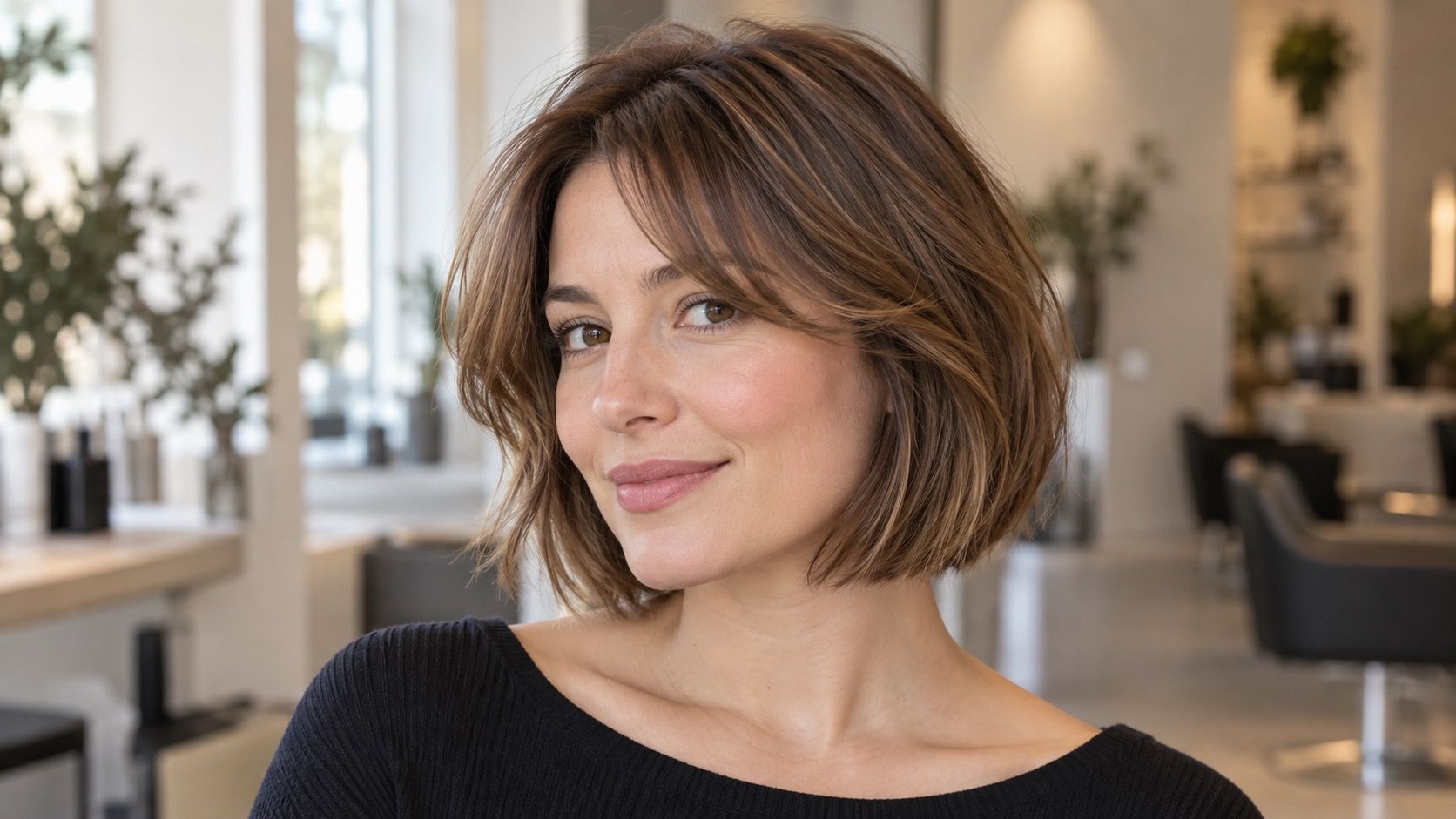
The useful question is not whether a haircut can make a round face look different in a diagram. It is whether it still feels like you after the morning rush, a humid walk, and a quick photo under unforgiving overhead light. The best hairstyles for round faces usually give you a few choices in where the eye travels: a little height, movement beside the cheeks, or a line that lands below them. A try-on is valuable because it lets you compare those choices before a stylist removes six inches.
Begin with proportion, not a face-shape rule
A round face is often described as similar in width and length, with softer transitions at the jaw and cheek area. That is a starting observation, not a sentence handed down by a haircut tribunal. Hair density, glasses, a pronounced forehead, and the way you carry your shoulders can change what a cut looks like. Two people can select the same collarbone lob and get entirely different balance.
In a round face hairstyle try on, keep your expression neutral for one view and smile for another. A smile changes the cheek area and can make a short cut appear wider than it did in the still, serious image. Also test a front-facing image beside a three-quarter angle. If a style only works from one frozen position, it may be a disappointing salon reveal.
Rather than asking a filter to narrow anything, look for placement. Does the strongest part of the haircut sit exactly at the fullest point of your cheeks, drift past it, or rise toward the crown? None is automatically wrong. The decision is about whether you like the emphasis and can reproduce the finish with your own brush, dryer, and ten spare minutes.
Choose length by where the ends actually land
For many haircuts for a round face, ends that fall below the cheekbone create a calmer vertical line. A long bob that brushes the collarbone is popular for a reason: it is long enough to move when you turn your head, but not so long that it collapses into a single heavy curtain. Ask to preview it both tucked behind one ear and worn loose; that small change is often the real test.
A chin-length bob can look sharp and lively, especially with an off-centre part or an airy bend through the ends. The caveat is literal: measure where the chin is on your own image, not on a model with a different neck length. A blunt line that stops at the widest cheek area has a more graphic, deliberate effect. If that is what you want, own it; do not expect it to behave like soft layering.
Long hair is not ruled out. Long hair with a centre part and one unbroken length can simply make every feature look more symmetrical and still. Adding face-framing pieces beginning around the lips or jaw gives it a reason to move. The better preview is not the perfectly curled version; try a lightly air-dried wave too, because that is where most long hair spends Tuesday morning.
Use layers to create movement, not a helmet
Soft layers work best when their starting point has been chosen with care. Short layers beginning at the cheek can bring attention there, while longer layers beginning below the jaw often create a downward sweep. Neither is a universal fix. Compare them with the same parting, then with your usual part. Otherwise you are comparing two variables and learning very little from the image.
Fine hair needs another check. A heavily layered reference photo may have been styled with a round brush, clip-in volume, and a generous amount of product. On fine hair, too many internal layers can make the lower edge look sparse after a few weeks. Keep a solid baseline at the ends and ask for subtle surface movement instead of chasing every feathered strand in a celebrity photo.
Thick or wavy hair has the opposite trap: removing bulk can make the silhouette easier, but short crown layers can puff up before they settle. Preview a version with moderate crown volume rather than a towering blowout. If your natural texture has a bend, a cut that allows that bend to live is usually more useful than one requiring a daily argument with a straightener.
Preview bangs at ordinary, not perfect, styling
Bang decisions are where a virtual test can save real regret. Curtain bangs can open at the centre and blend into longer face-framing pieces, so they often feel less abrupt than a straight fringe. For a round face, the important detail is their outer length: pieces that extend toward the cheekbone or jaw can create a soft diagonal, whereas very short, round curtains can read as a separate puff above the face.
A full fringe changes the visible forehead and can make a cut feel more compact. That can be charming with a textured bob, but it is high-maintenance if your hairline separates, gets oily quickly, or has a stubborn cowlick. In the try-on, inspect the fringe with your eyebrows fully visible and then with it slightly separated. Real bangs rarely retain their launch-day shape past lunchtime.
| Option to preview | What to inspect | Practical caveat |
|---|---|---|
| Long curtain bangs | Where the longest pieces end | They need regular blending trims |
| Side-swept fringe | Whether your natural part supports it | Can fall flat in rain or humidity |
| Short textured fringe | How much forehead stays visible | Usually needs daily styling |
The point is not to avoid bangs. It is to see them as a small haircut within the larger haircut, with their own growth pattern, wash schedule, and trim appointments. A great image cannot answer those questions, but it can make the questions obvious before the appointment.
Test parting and crown volume before calling it a match
A middle part can look clean on a round face, particularly when the lengths have some lift away from the cheeks. It is not forbidden; it just exposes symmetry clearly. If the preview feels flat, change only the root direction first. A slight off-centre part may give enough asymmetry without the dramatic sweep of a deep side part.
Side parts can add a diagonal that breaks up a very centred look, but there is a trade-off. A deep part with all the volume on one side can make fine hair look thin on the opposite side, and it may disappear when you switch your head position. Test it with your usual glasses if you wear them. The arm of the frame can pin one side flat and change the silhouette more than expected.
Crown volume is useful when it is believable. Lift of a centimetre or two at the roots can make a layered cut feel lighter; a tall, rigid bump can turn the whole style into a special occasion. In the salon, ask the stylist to show the cut after a rough dry as well as after a polished finish. That is the closest thing to a truthful preview.
Bring a decision, not a demand, to the salon chair
Save two or three try-on views: your favourite, a safer alternative, and one bolder option. Then explain what you noticed rather than saying you need a cut for a round face. For example: you may like how the collarbone length moves below the cheeks, but want less layering because your hair is fine. That gives a stylist material they can use.
Ask what happens at the six-week mark. A cut with curtain fringe may still look intentional then; a precise jaw-length bob may already feel like a different cut. Ask which parts should be trimmed separately, how the layers will grow out, and whether the reference assumes heat styling. These are not fussy questions. They are the difference between choosing a photo and choosing a routine.
Finally, leave room for taste. A blunt bob that places attention at the cheeks may be exactly the striking look you prefer, even if standard advice would choose long layers. The most useful haircut is not the one that obeys a face-shape chart. It is the one whose shape, upkeep, and everyday version all make sense to you.