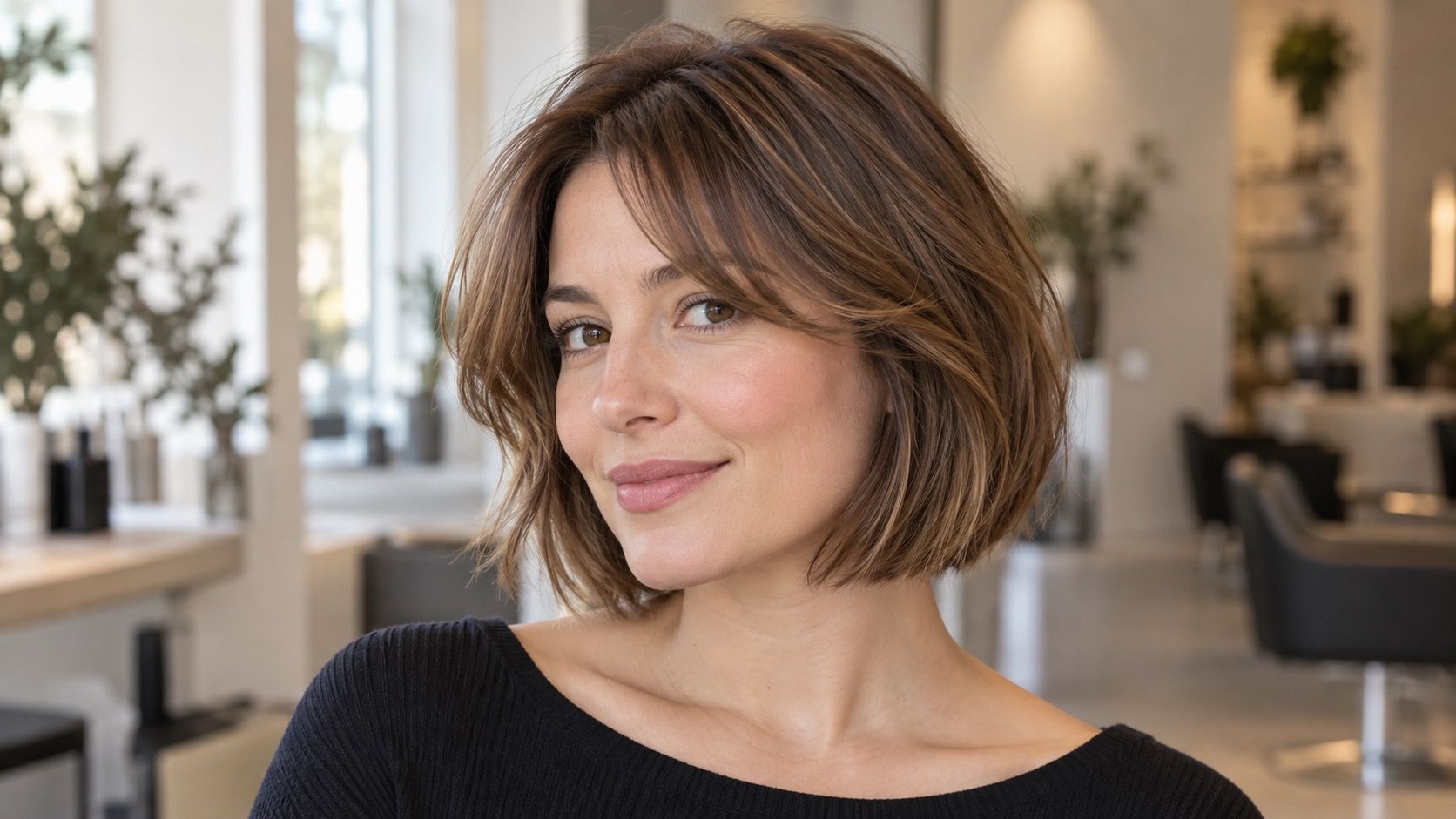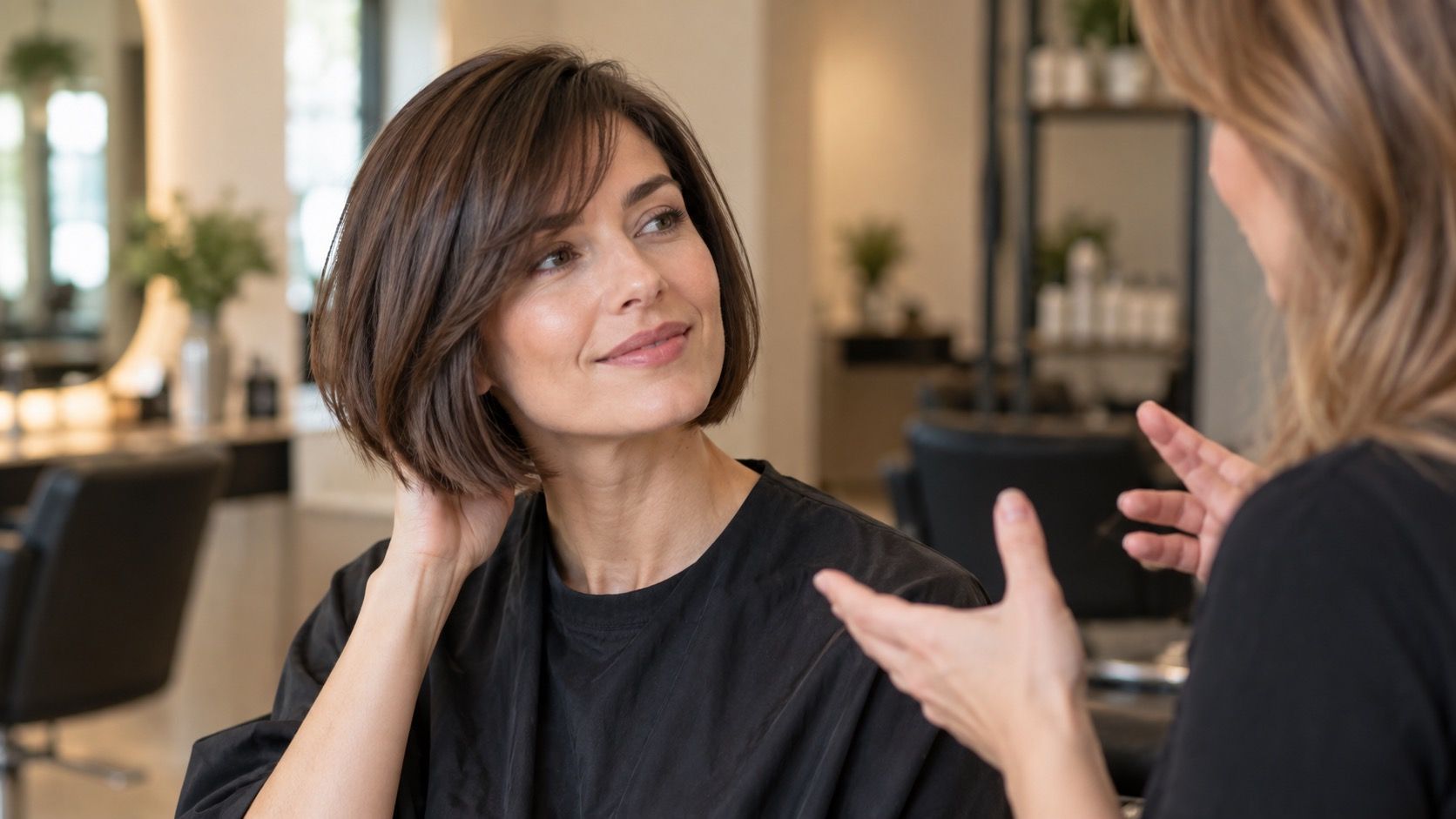
A square face does not need to be disguised, softened away, or corrected. It has a clear jawline and often a strong, memorable outline; the practical task is choosing how a haircut joins that outline. Some people want a similarly crisp bob. Others prefer waves or layers that move around the jaw. The best hairstyles for square faces are the ones you have assessed in your own texture and routine, rather than borrowed from a before-and-after caption.
See what the preview is actually showing you
When you use a square face hairstyle try on, look at the relationship between the haircut and the jawline rather than hunting for a flattering verdict. Is the strongest horizontal line at the chin, above it, or below it? Does the hair sit close to the temples, or does it have soft width beside the cheeks? Those are style choices, and it is useful to name them.
Use a photo with your usual part and no dramatic head tilt. A tilted head can make a side fringe look effortless, while a straight-on view tells you whether it still has balance. Check a three-quarter image as well: a square face has structure from more than one angle, and a cut that looks good only in a front-facing app view is not much of a plan.
Lighting matters more than people admit. Hard bathroom light makes blunt edges and compact volume look sharper; daylight can make the same cut look softer. Compare the preview at a normal size, not just zoomed in. If the overall outline feels too severe or too vague from a distance, changing one small layer often helps more than adding a complicated style.
Decide whether you want contrast or movement at the jaw
A blunt bob at chin level can echo a square jaw in a confident, graphic way. That is not a mistake. The risk is assuming it will look like a smooth editorial image if your hair tends to bend outward at the ends. Preview the bob with a slight natural kick and with hair tucked behind one ear; those are the moments that decide whether the shape feels deliberate or merely awkward.
Soft layers can take the visual emphasis away from a single hard line. Long layers starting below the jaw give hair a downward, moving edge, particularly with a loose wave. For straight hair, keep the layers restrained so the ends do not become wispy. A heavy thinning approach may create movement in the salon but leave you with frizz and a weaker outline at home.
A shoulder-length wavy bob is a sensible middle ground. It has enough length to fall beside the jaw and enough structure to feel like a haircut, not a transition. The important comparison is between an air-dried wave and a carefully tonged wave. If you only like the latter, factor in the extra fifteen minutes before booking it.
Place bangs and the part with your hairline in mind
Curtain bangs can introduce a soft diagonal from forehead to cheek, especially when their longer pieces blend into layers. Their opening should be tested with your real parting. If a natural cowlick pushes the fringe apart, a perfectly central curtain may be a daily fight. A slightly uneven opening can look more natural and be much easier to manage.
A side fringe gives a stronger sweep across the forehead and can work beautifully with a side part. It is worth checking both sides of your face in a preview, because most faces are not perfectly symmetrical. You may prefer the fringe to travel toward one eyebrow, and that preference is more valuable than a generic rule about which side is best.
| Feature | Preview it with | Watch for |
|---|---|---|
| Blunt bob | Natural ends and a tucked ear | An edge that flips outward |
| Curtain fringe | Your usual centre or off-centre part | A gap caused by a cowlick |
| Side part | Glasses, if you wear them | One side becoming flat |
Full straight bangs can be equally good, but they make a horizontal statement. They are most convincing when you like that contrast and are willing to dry them separately. A fringe is not a one-time choice: it is a small daily styling project with a trim schedule.
Preview short styles without treating them as a test of bravery
Short hair can put a square face in clear view, which may be exactly why it appeals. A textured pixie with longer pieces around the forehead can balance a close nape; a cropped cut with little movement reads cleaner and more architectural. Do not let the words soft or feminine make the decision for you. Ask whether you want visibility, texture, or a sharp outline.
For a short bob, the neck makes a difference. A shorter neck can make a high stacked shape feel more compact, while a longer neck may carry it easily. In a try-on, compare the nape line and the front length independently. The front can remain soft and slightly longer even if the back is neat, creating a shape that grows out with less drama.
Short cuts require more frequent adjustments than long layers. Before choosing one, ask what it looks like at four weeks and eight weeks, not just on cutting day. If you love the shape only at its most precise, make sure the upkeep fits your calendar and budget.
Let your natural texture make the final call
Straight hair makes lines obvious, so a blunt cut or a clean side part will read strongly. Adding a bend around the ends can change that without committing to a permanently layered shape. Try a version with a subtle bend first; it may supply all the softness you were searching for.
Wavy and curly hair already has movement, but it can build width at the sides. That may be a lovely, expansive look. If you prefer a more vertical outline, a stylist can adjust the internal weight and where the layers begin. Avoid asking for maximum thinning without discussing frizz; removal is not the same as control.
The successful choice is rarely a single rule such as long hair only or side part only. It is an agreement between your jawline, texture, preferred finish, and tolerance for work. Bring those observations to the chair, and a stylist has far more to work with than a label from an app.
Turn the try-on into a useful salon conversation
Save one image that shows the length you want, one that shows the texture, and one that shows the fringe or parting. They may not be the same image. Saying that you like the movement of one and the perimeter of another is more honest than pretending there is a perfect reference photo.
Ask how the cut will behave without a blowout, where the layers will sit after growth, and what product does the most useful work. A good answer should sound concrete: perhaps a lightweight cream for the ends, or a small round brush for fringe. Vague promises of effortless volume deserve some suspicion.
Then choose the version that feels like an extension of your taste. A square face can carry structure, softness, or a mixture of both. The haircut should not erase that character; it should give it a shape you enjoy wearing.